
Estimated reading time: 6 minutes
A New Era of Cyber Threats
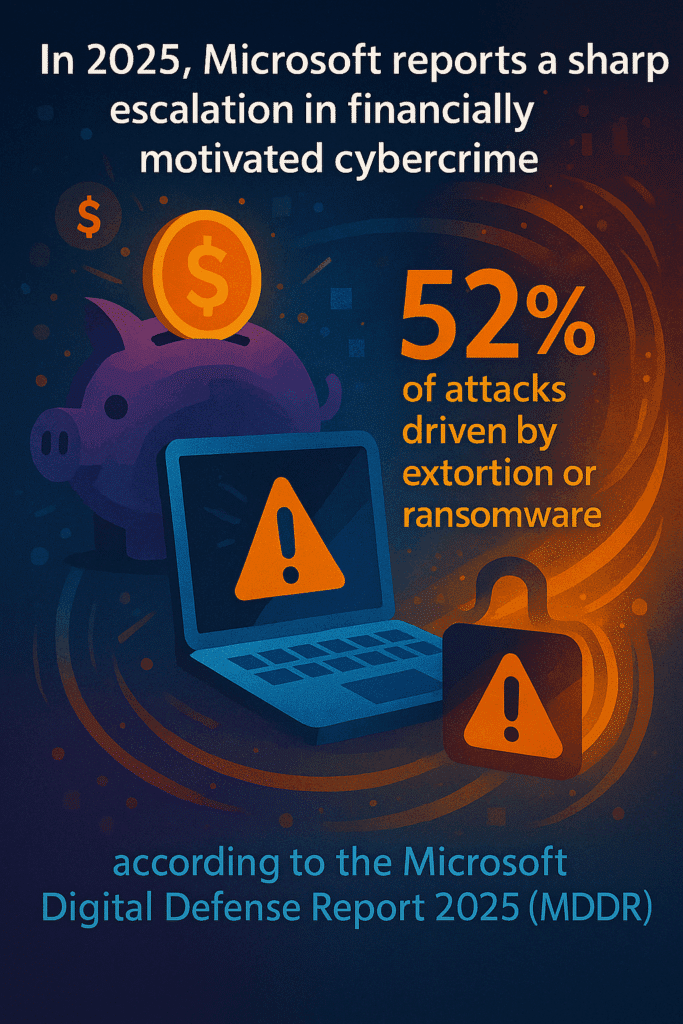
An increasingly evident arms race is unfolding in cyberspace. Algorithms duel, AI fights AI, and every click could spark a crisis. Microsoft’s new Digital Defense Report 2025 warns that the digital battlefield has gone fully commercial — and cash, not chaos, is the new currency of attack. In 2025, Microsoft reports a sharp escalation in financially motivated cybercrime. Over half of all attacks with known motives, 52%, were driven by extortion or ransomware, according to the Microsoft Digital Defense Report 2025 (MDDR). Corporate Vice President for Customer Security and Trust, Amy Hogan-Burney, described this as a defining moment for cybersecurity. “Cyber threats are rapidly evolving from technical problems affecting business to events impacting all aspects of our society,” she said.
The findings, co-authored by Microsoft’s CISO, Igor Tsyganskiy, reveal a troubling trend: attackers are using automation, AI, and off-the-shelf tools to breach systems more quickly and effectively. Eight out of ten incidents involved data theft, signaling a pivot toward monetizing stolen data rather than pure disruption.
Extortion Over Espionage
The report’s executive summary notes that financial gain far outweighs espionage as a motive. Just 4% of attacks were linked to nation-state espionage. In contrast, 33% involved extortion, and 19% involved ransomware or destructive activity. Microsoft’s incident response teams also found data theft in 80% of engagements. That reinforces the belief that today’s threat actors are driven by profit.
That said, Microsoft emphasizes that these state actors are increasingly leveraging the same tools and ecosystems as cybercriminals, making attribution more challenging.
As the report puts it, “Adversaries aren’t breaking in—they’re logging in.” Attackers use stolen credentials from the dark web to infiltrate systems, bypassing traditional security barriers.
Critical Services Under Fire
Vital entities, such as hospitals, schools, and local governments, remain prime targets due to outdated software and limited cyber budgets. The consequences are increasingly real and even life-threatening: disrupted emergency services, delayed medical care, and halted public transport.
Ransomware groups exploit the “must-pay” pressure on these sectors, knowing that downtime can be catastrophic. The report warns that cyberattacks on critical infrastructure “are no longer isolated incidents—they ripple through society, affecting safety and trust.”
Nation-State Operations Evolve
Nation-state cyber operations continue to expand but remain focused on intelligence gathering.
- China continues to engage in large-scale espionage, targeting communications and research networks.
- Iran has expanded its reach to North America and Europe, with a notable focus on targeting logistics and shipping firms.
- Russia has shifted from Ukraine-specific campaigns to targeting NATO small businesses, increasing activity by 25% year-over-year.
- North Korea, still focused on funding its regime, uses global IT contractors and extortion schemes to generate revenue.
Watch our Newest Podcast On Ransomware Response: Expert Negotiation and Cyber Insurance
AI: Weapon and Shield
AI has redefined the cyber landscape on both sides. Attackers now utilize generative AI to automate phishing, create deepfakes, and expedite vulnerability discovery. In response, defenders, including Microsoft, use AI to analyze trillions of daily signals to preempt threats.
Every day, Microsoft processes:
- 100 trillion security signals,
- 4.5 million malware blocks,
- 38 million identity risk detections, and
- 5 billion emails screened for phishing.
“AI has become both a defensive necessity and a target,” Tsyganskiy cautioned. Attackers now deploy AI-powered malware that can adapt in real-time, challenging defenders to move beyond static defenses.
Identity: The Weakest Link
The report reveals a 32% rise in identity-based attacks in early 2025. That’s an alarming 97% of identity attacks involved password guessing or credential theft. Infostealer malware is booming, giving criminals easy access to user tokens and accounts. Microsoft urges all organizations to adopt phishing-resistant multi-factor authentication (MFA), which can block over 99% of identity attacks.
Two Minute Watch – Deepfake Scams Are Here – They Might Cost You Your Next Job!
Cloud and Supply Chain Risks Expand
Attackers are increasingly exploiting cloud misconfigurations, API abuse, and third-party vulnerabilities. “Even a small vendor can become an attack vector,” Microsoft warns.
The report details a February incident in which a ransomware attack on a shipping company was neutralized in under two minutes. This prevented a global trade disruption. The event highlights both the fragility of our interconnected systems and the fact that resilience can be attained through investment.
Cyber Mercenaries and Covert Networks
The rise of cyber mercenaries, AKA hackers for hire, poses new geopolitical risks. Over 430 known entities now operate across 42 countries, selling exploits and offensive tools. These commercialized attack services blur the line between espionage and profit-driven crime.
Microsoft’s Digital Crimes Unit (DCU) is actively dismantling such groups, having recently disrupted the Lumma Stealer infostealer network with Europol and the U.S. Department of Justice.
Get The Cyber Insurance Upload Delivered
Subscribe to our newsletter!
AI and Quantum: The Next Frontier
Beyond AI, quantum computing poses a significant threat to encryption. The report notes that now is the time to act, recommending that organizations begin post-quantum cryptography (PQC) transitions. “It’s not science fiction—it’s strategic foresight,” the report states.
The Way Forward: Shared Defense
Microsoft’s central message is that cybersecurity is a shared responsibility. The report outlines ten key recommendations for executives and boards, including:
- Treat cyber risk as a boardroom issue.
- Prioritize identity protection.
- Invest in people, not just technology.
- Build resilience through training and backup systems.
- Join intelligence-sharing networks.
Governments also play a critical role. The report applauds recent efforts to impose indictments and sanctions on malicious actors, noting that “credible consequences are essential to global deterrence.”
Conclusive Analysis and Strategic Recommendations
The Digital Defense Report concludes with a call for proactive governance. As many other voices have noted, cybersecurity is no longer a back-office issue; it’s a national and economic security imperative.
AI, automation, and international collaboration form the backbone of Microsoft’s Secure Future Initiative, which aims to strengthen global cyber resilience. “Defenders must act faster, share more, and think collectively,” the report urges.
Plain Analogy: Cybersecurity as Public Health
It all might seem new, it is. But the challenge is one we have met in similarly daunting moments. Consider public health in the 19th century. Over a hundred years ago, germ theory changed medicine. Once people understood invisible threats, sanitation became everyone’s job. Like microbes, extortion and ransomware are abstract forms of modern invisible threats that envelop us in ones and zeros. The cyber world is facing a similar awakening. Well, we hope it is.
Related Cyber Insurance and Cybersecurity Posts
