
Estimated reading time: 4 minutes
As cyber threats escalate, a new Trellix eBook report titled “Mind of the CISO: Closing the Gap Between Reaction and Readiness” reveals a sobering truth. Nearly all Chief Information Security Officers (CISOs) — 98% — struggle to act on cyber threat intelligence. Their challenges are not theoretical. Rising global threats, AI-driven malware, and pressure from nation-state cyber actors are reshaping cybersecurity priorities. Yet, many organizations remain stuck in reactive postures, unable or unwilling to implement proactive cybersecurity strategies.
Nation-State Threats Shape Cybersecurity Spending
Trellix’s research highlights the increase of nation-state threats and their impact on cybersecurity planning. CISOs report frequent inquiries from executives about foreign adversaries, such as China and Russia.
This attention has tangible impacts. About 85% of CISOs said that nation-state risks influence their cybersecurity budgets. A slightly higher percentage—87%—said these threats drive overall strategy.
In sectors like healthcare and government, this influence is even more acute. For instance, 90% of public sector CISOs worry that an attack on an ally could spill into their systems.
Reactive Cybersecurity: A Human Weakness
Why do companies wait until a breach to act? The answer is partly psychological.
Human beings often suffer from normalcy bias, a tendency to believe that things will continue as they always have. The barn door looks just fine until the horse is gone. We have written about this in our opinion section.
As John Fokker of Trellix explains, relying on reactive intelligence leaves companies vulnerable. Most CISOs agree on the value of threat data (94%). Yet, many admit their ability to collect, analyze, and integrate it needs significant improvement.
The urgency is apparent: 60% of companies haven’t fully integrated threat intelligence into their strategies. Only 44% take a proactive approach. The rest respond when the damage is already done.
AI and Automation: Underutilized Cyber Defenses
AI-powered threats are advancing, but many defenses are not keeping pace. One-third of CISOs believe AI and automation could significantly boost their effectiveness. Yet 28% said they lack the automation needed to integrate tools with threat programs.
This gap limits the speed of detection and response. With threat actors already leveraging AI for faster, smarter attacks, lagging in tech can be fatal.
To modernize, CISOs are seeking support—not just tools but also integration, compliance clarity, and investment in intelligent automation.
Get The Cyber Insurance News Upload Delivered
Every Sunday
Subscribe to our newsletter!
The Power of Peer Communities
Cybersecurity can be isolating. But Trellix’s report highlights a silver lining; the community. Some 95% of CISOs report that peer networks enhance their threat readiness.
Furthermore, 89% believe that CISO communities help them navigate high-stakes decisions. These spaces for shared experience and advice offer perspective in fast-moving crisis environments.
Information-sharing networks also help democratize knowledge, particularly for smaller organizations that may lack robust internal threat intelligence capabilities.
A Shift from Tactical to Strategic Threat Intelligence
Currently, threat intelligence is often used tactically. For example, 51% of organizations use it to train teams, while 48% use it to update policies. These are important but limited.
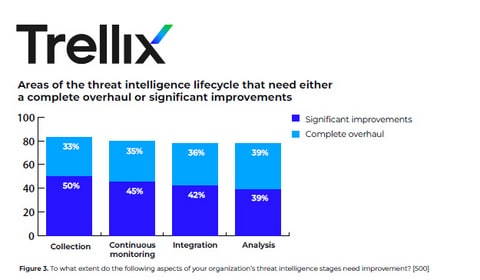
Strategic use means integrating intelligence into long-term planning and decision-making. It requires better collection, analysis, and continuous monitoring. The report found that over 80% of CISOs believe every stage of the intelligence lifecycle needs significant improvement or a full overhaul.
Without this shift, companies risk wasting their data and falling behind attackers.
Cybersecurity Strategy
At its core, a strong cybersecurity strategy aligns people, technology, and processes to anticipate and neutralize threats before they materialize.
Let us be clear. This is no small task.
It means overcoming inertia, bridging silos, modernizing infrastructure, and fostering a culture of readiness. It also means understanding that cybersecurity is no longer just an IT issue; it has some time. This is a vital component of any business’s strategy.
Explain it like I’m a 5th Grader or The CEO: Cybersecurity Is Like Brushing Your Teeth
Cybersecurity today is like dental hygiene. Everyone knows you should brush and floss daily. However, many only visit the dentist when they experience pain.
By then, the cavity has set in. A filling—or worse, a root canal—is inevitable.
Trellix’s report urges organizations to stop waiting for toothaches. Instead, build daily habits, invest in prevention, and keep that cybersecurity smile healthy and strong.
RELATED NEWS:
