
Estimated reading time: 4 minutes
JPMorganChase’s Security and Resiliency Initiative Examined
Yesterday, JPMorganChase announced a $1.5 trillion Security and Resiliency Initiative, a 10-year plan designed to enhance America’s economic and digital strength, improving critical industries. While “cybersecurity” is only mentioned directly in one of the four pillars, investment in it quietly powers all of them. CEO Jamie Dimon emphasized urgency and scale: “Our security is predicated on the strength and resiliency of America’s economy… We need to act now.”
This initiative is organized into four pillars:
- Supply Chain and Advanced Manufacturing
- Defense and Aerospace
- Energy Independence and Resilience
- Frontier and Strategic Technologies
Each area embeds cybersecurity demands, illustrating how cyber resilience is foundational to modern economic stability.
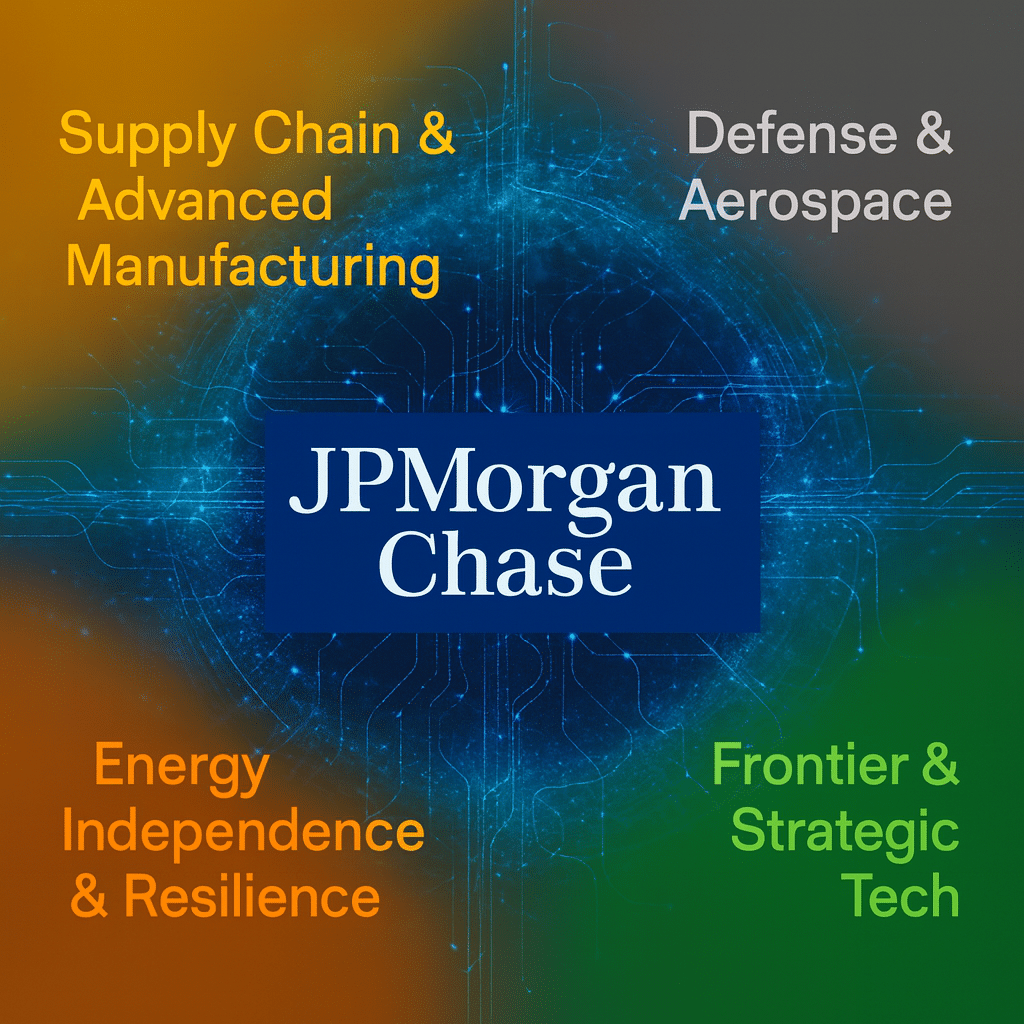
How Cybersecurity Investment Threads Through Every Pillar
Supply Chain and Advanced Manufacturing
Cybersecurity investment here focuses on mission-critical infrastructure such as data centers, automation networks, and connected manufacturing systems.
- “Mission Critical Real Estate” points to secure data centers, hubs for uptime, redundancy, and security by design.
- “Automation & Networking” introduces new attack surfaces in smart factories, underscoring the need for network segmentation and real-time threat detection.
Defense and Aerospace
In this pillar, secure communication systems, mesh networks, and 6G technologies depend on advanced cyber defense frameworks. Cyber investments in command and control systems and unmanned platforms ensure operational resilience across military and aerospace operations.
Energy Independence and Resilience
Protecting grid resilience, distributed energy resources, and battery storage is no longer optional. Here, cybersecurity funding supports the protection of operational technology (OT) and industrial control systems (ICS), incident response, and system segmentation. These safeguards maintain America’s power systems’ stability and security from cyber threats.
Frontier and Strategic Technologies
This is the only pillar that explicitly mentions cybersecurity — focusing on AI, quantum computing, and cyber resilience.
By strengthening edge computing, sensor hardware, and biotech security, JPMorganChase aims to push security innovation to the network edge, where the next wave of digital battles will occur.
WATCH – The Looming Global Cyber Attack: Are We On The Doorstep of Digital Disaster?
Cybersecurity as Economic Infrastructure
Dimon tied cybersecurity investment directly to national and economic security. By reducing reliance on “unreliable sources of critical minerals, products, and manufacturing,” the initiative aims to secure America’s industrial backbone.
This approach reframes cybersecurity not as a cost center but as core economic infrastructure — essential for maintaining competitiveness and sovereignty in a rapidly digitizing world.
Why Cybersecurity Investment Is Now a Financial Priority
Cyber failures today often translate into business failures, especially in sectors that JPMorganChase is funding.
The initiative signals a market-wide revaluation: cybersecurity isn’t just an IT issue, it’s a strategic investment with measurable financial outcomes.
For insurers and investors, this shift means:
- Underwriting follows cyber risk, new policies will target these sectors.
- Valuations will depend on cyber maturity, resilient companies will command premiums.
- Cyber risk transfer becomes an operational necessity.
The takeaway: cybersecurity investment defines the next generation of economic resilience.
Get The Cyber Insurance Upload Delivered
Subscribe to our newsletter!
The Connective Tissue of Cyber Resilience
Cyber resilience permeates all four pillars, much like a nervous system. Every initiative, from secure manufacturing to AI innovation, relies on trusted and secure digital infrastructure.
The $1.5 trillion in capital flow, therefore, acts as both a security investment and a national competitiveness strategy. As Dimon urged: “America needs more speed and investment.” The future depends on how quickly we embed cybersecurity into everything we build.
The Bottom Line
JPMorganChase’s 10-year initiative is yet another indication that cybersecurity investment is no longer an isolated concern; it’s the foundation of every modern industry.
From power grids to aerospace to manufacturing, digital resilience defines the strength of nations and the businesses within them alike.
As cyber threats evolve, investments in security architecture, risk management, and AI-driven defenses will decide which organizations thrive.
Related Posts
