

Estimated reading time: 6 minutes
Cyber risk is forcing boards, CEOs, and CISOs to confront the gap between knowing change is constant and actually managing it. Our language is full of warnings about this reality. “The only constant in life is change.” “Adapt or perish.” And the idea often attributed to Darwin still resonates because it captures the stakes so well: it is not the strongest that survive, but those that best manage change. In cybersecurity risk, seeing change is not the same as acting on it. In action with regard to managing cyber risk creates an opening. That gap now sits at the center of one of the most urgent leadership challenges facing modern organizations.
Cyber risk is not just an IT issue. It affects everyone in a company, from the board and CEO to legal, finance, operations, and all employees. Yet, many organizations still see it as only a technical problem. In the latest Cyber Insurance News and Information Podcast, Martin Hinton talks with Max Martina, president of Cambridge Leadership Associates, about why this view exists and persists. And the danger it creates. They discuss leadership, how the role of the CISO is changing, the problems caused by silos and perceptions, and why adaptive change is needed for real resilience.
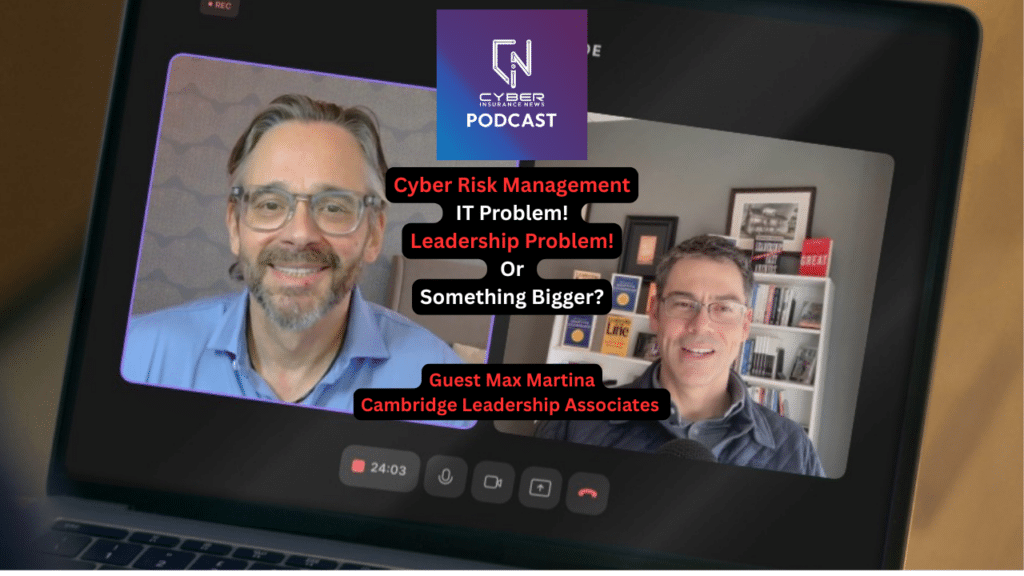
FIND THE PODCAST HERE
Understanding Cyber Risk As An Adaptive Challenge
This episode starts with a sharp distinction. Some problems are technical. Others are adaptive. Technical problems call for expertise and established tools. Adaptive problems force people and organizations to change how they think and behave.
This distinction matters because cyber risk is often misunderstood. When it is seen only as an IT issue, it can lead to underfunding, isolation, and a lack of shared responsibility. The episode explains how this common mistake creates risks for leaders and the enterprises they manage.
The Role Of Leadership In Cybersecurity
Martina makes a clear point: a major cyber incident can show a failure in leadership. This does not mean one person is always at fault. Instead, it means the organization did not bring together focus, authority, and action to address a known threat.
This part of the discussion shows that leadership in cyber risk is more than just having a title. It is about making progress on tough issues and making hard choices before a crisis happens.
The CISO’s Position And Responsibilities
The episode focuses on the CISO role. Where the CISO sits in the organization shapes cyber risk management. A CISO placed within IT may struggle to secure resources or influence peers; one with greater executive access can frame cyber risk as an enterprise issue.
Martina argues that top CISOs go beyond managing controls: they build coalitions, connect departments, and translate technical risk into business terms. This approach matters because cyber risk is diffuse; one click can have enterprise-wide consequences.
Building Coalitions And Psychological Safety
One of the strongest themes in the episode is that resilience depends on relationships. Companies do not respond well in a crisis if teams do not trust one another before the crisis begins.
Psychological safety matters in cyber risk. Employees must feel safe reporting mistakes, suspicious activity, and near misses. CISOs need support, not blame. Without this, organizations default to blame, delays, and work avoidance when clarity and speed are needed.
Resilience Vs. Readiness In Cyber Risk
A key part of the podcast looks at the difference between being ready and being resilient. Having policies, playbooks, and response plans is important, but these alone are not enough.
Real resilience appears when things get tough. Can teams talk to each other? Can they work together across departments? Finally, can they adjust when systems break down? Martina’s examples make this clear and show why boards and executives need to look past just having checklists.
Get The Cyber Insurance News Upload Delivered
Subscribe to our newsletter!
Organizational Culture, Governance, And Repeated Failures
Why do even smart companies repeat the same cyber risk mistakes? The episode points to company culture, incentives, and governance as reasons. Turf wars slow things down. Focusing only on costs limits perspective. Leaders often wait for certainty instead of getting ready for disruption.
This insight makes the conversation especially helpful for boards, CEOs, and insurers. It shows that moving forward is not just about fear. It is about having better stories, stronger governance, and clearer agreement on what cyber risk really means.
AI, Adaptive Leadership, And The Future Of Cyber Risk
The discussion ends by looking to the future. AI could strengthen cybersecurity, but it also makes things more complex. This means leadership is more important than ever.
Martina’s main point is clear. Organizations need leaders who can truly understand cyber risk, get support from across the company, and lead adaptive change. For boards, CISOs, and insurers, this episode gives a timely way to think about cyber risk more realistically and usefully.
Get the full conversation on YouTube. Other Options Below
Also Get it here
Transcript Has Been Checked For Accuracy, But Confirm Elements Against The Recording.
Podcast FAQ: Cyber Risk, Leadership, And The CISO
Key Insights From The Conversation
Cyber risk is not just a technical issue. It is a leadership challenge that requires organizations to change behavior, not just deploy tools.
Many organizations frame cyber risk as an IT problem. This limits ownership and prevents broader enterprise engagement.
An adaptive problem requires people to change how they think and act. Cyber risk falls into this category because it involves culture, behavior, and decision-making.
When leaders fail to align priorities and resources, cyber risk grows unchecked. A breach often reflects missed decisions, not just technical gaps.
The CISO must balance technical expertise with influence across the organization. Success depends on communication, not just controls.
FAQ Resilience, Culture, And The Future Of Cyber Risk
Cyber risk is spread across departments. CISOs must build relationships to align teams and drive shared responsibility.
Readiness is having plans and tools. Resilience is the ability to act effectively under pressure when those plans are tested.
A culture of blame discourages reporting and slows response. Psychological safety enables faster, more effective action.
They focus on technical fixes instead of systemic issues like incentives, silos, and governance.
AI can strengthen defenses, but it also increases complexity. Leadership must adapt quickly to manage both the risks and opportunities.
Related Cyber Liability Insurance Posts
- TMK Expands Cyber Liability Insurance Team With Francesca Kevill Appointment
- Cyber Warfare Escalates Worldwide As AI Turns Digital Conflict Into Constant Pressure
- Cybersecurity Starts With Understanding: Graylog’s Kimber Spradlin on Data Clarity, AI Limits, Cyber Hygiene and Mom
- Data Governance and Cyber Risk: Why Data Sprawl Is the Hidden Liability – NEW PODCAST
- Cyber Resilience Under Fire: New Data Exposes a Global Confidence Gap
