
Estimated reading time: 4 minutes
Cyber insurance growth has stalled after a decade of rapid expansion. So where does the market go from here? That’s the central question of Howden’s new report, Cyber Insurance: Rebooting Growth. The analysis warns that the once red-hot market now faces slowing momentum, even as cyber threats rise. Yet, it also points to new frontiers—especially in Europe—where the potential for growth remains vast.
The Rise and Stall of Cyber Insurance
Over the last decade, cyber insurance has been one of the industry’s most successful success stories. Surging demand matched the rise in ransomware attacks, data breaches, and business interruption events. “Insured companies are better protected than ever thanks to stronger governance and risk management,” the report notes.
But after years of double-digit growth, the market is cooling. Prices are falling, competition is heating up, and the customer base isn’t expanding fast enough. That slowdown has left brokers, insurers, and investors asking where future growth will come from.
Europe’s Untapped Potential
One clear answer is Europe. In the region’s largest economies—Germany, France, Italy, and Spain—more than 70% of companies remain uninsured, raising concerns about their cybersecurity.
The numbers reveal stark contrasts: only 22% of Italian businesses hold cyber liability insurance, compared with 39% in the UK. Despite this gap, cyber risks are no less severe. Almost half of the companies in the four surveyed countries reported at least one cyberattack in the last five years. Those attacks cost an estimated €307 billion in direct losses.
“Urgency and opportunity are moving in the same direction, and the implications for buyers are significant,” said Shay Simkin, Chair of Howden Cyber.
Key Numbers
The Business Case for Cybersecurity Coverage
The report argues that cyber insurance delivers a strong return on investment. A business generating €500 million in annual revenue can save roughly €16 million in cyber-attack-related costs over a decade. That translates to a 19% ROI.
Even more telling, 41% of large enterprises in Europe say they plan to purchase cyber insurance for the first time within five years. With premiums currently softening into low double-digit declines, new buyers may find today’s market conditions especially attractive.
Shaping the Next Phase
Howden emphasizes that coverage should be viewed as more than a transfer of risk. It strengthens corporate governance, accelerates recovery, and minimizes financial fallout. “Cyber insurance is not just a protective measure, but a strategic enabler of resilience,” said Jean Bayon de La Tour, Head of Cyber, International at Howden.
To sustain growth, insurers must deepen partnerships with cybersecurity experts, align with (re)insurers and capital providers, and expand into underserved regions. Those steps, the report suggests, will help reset the industry for its next growth cycle.
Get The Cyber Insurance News Upload Delivered
Subscribe to our newsletter!
Key Numbers from the Report
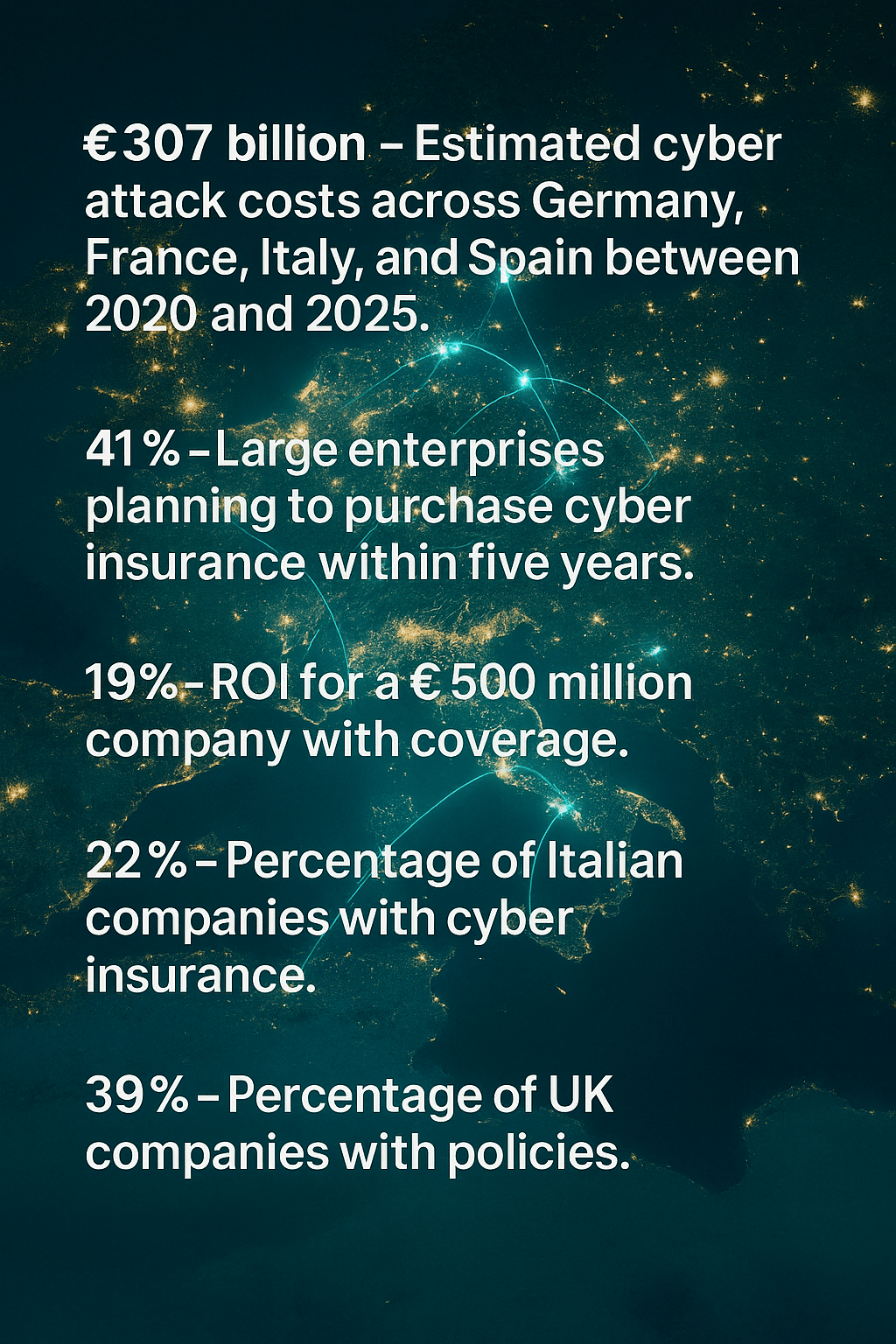
- €307 billion – Estimated cyber attack costs across Germany, France, Italy, and Spain between 2020 and 2025.
- 41% – Large enterprises planning to purchase cyber insurance within five years.
- 19% – ROI for a €500 million company with coverage.
- 22% – Percentage of Italian companies with cyber insurance.
- 39% – Percentage of UK companies with policies.
Everyday Analogy
Think of cyber liability insurance and maintaining cybersecurity like gym memberships. A decade ago, everyone rushed to join, driven by new fitness fads and fears of poor health. Now, growth has slowed. The people most committed are already inside, sweating it out and keeping themselves fit. The next wave of cyber resilience growth lies in convincing those who’ve stayed outside—like businesses in Italy, Spain, and Germany—that the benefits are tangible, measurable, and worth the cost.
Related Posts
