

Estimated reading time: 5 minutes
Knock, knock. Who’s there? Your cyber insurer is checking whether your identity controls deserve a cyber insurance policy at all. A new Delinea research report shows that identity security now stands at the front door.
Identity Checks Now Define the Cyber Insurance Policy Market
Delinea’s 2025 Cyber Insurance Research Report finds identity controls now influence almost every cyber insurance policy decision. Ninety-seven percent of surveyed organizations say identity-related controls affect premiums or coverage terms.
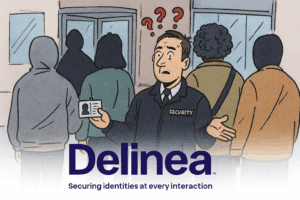
Almost all respondents (99.5%) say some security controls are required before a cyber insurance carrier offers coverage at all. In practice, the cyber insurance policy now serves as a blunt audit of identity maturity. Insurers want proof of threat detection, least-privilege access, strong passwords, and secure third-party connections before signing anything.
Art Gilliland, Delinea’s CEO, captures the shift simply: “Insurers are sending a clear message.” Affordable coverage now follows the strength of visible identity.
Key Findings: Claims, Costs, and Scrutiny Climb Together
Cyber insurance is getting used, not just filed away.
- Seventy-two percent of organizations filed a cyber insurance claim in the past year, up ten points from 2024.
- More than a third, 37%, filed multiple claims over the same period.
- Those claims have a price.
- Seventy percent of organizations say their cyber insurance costs increased this year. Only a tiny minority saw reductions.
Insurers are responding with tougher reviews.
- Seventy-seven percent required internal IT and security assessments.
- Half required external risk assessments.
- 51% pushed their preferred security tools or appliances onto customers.
Most organizations also had to buy new tools to renew coverage. Threat detection, access controls, and session monitoring led that shopping list.
Cyber insurance now behaves like a continuous audit, not a static contract.
Key Finding: Coverage Gaps and Void Traps
The report warns that having a policy does not guarantee “coverage safety.”
- Sixty percent of policies cover data recovery after an incident. Only 33% covers lost revenue from that same event.
- Less than half of policies cover ransomware negotiations or payments, despite strong demand for that protection.
- Legal support is also uneven. The share of policies covering legal fees dropped from 44% to 39% this year.
Then come the “void” clauses.
- Forty-five percent of organizations say their coverage can be voided if required security controls are missing.
- Human error and misconfigurations trail close behind as contract killers. 36% cite human error, while 35% cite misconfiguration as a void trigger.
- Acts of terrorism, acts of war, internal bad actors, and late reporting also sit in the fine print.
Get the Cyber Insurance Upload Delivered
Subscribe to our newsletter!
The key takeaway: a Cyber Insurance Policy behaves like a conditional promise. Controls, configuration, and behavior decide whether that promise survives a claim.
Key Finding: Identity-First Controls Shape Insurability
The strongest signal in the report is clear. Identity-first security now decides who gets insured, on what terms. Only 2.5% of respondents saw no impact from identity-related controls on coverage terms at renewal.
Among identity controls, one stands out.
- Privileged Access Management (PAM) is the top differentiator for underwriters, named by 41% of organizations.
- Identity Governance and Administration (IGA) follows at 38%.
- Third-party and vendor access controls rank next at 32%.
Those priorities track directly to real incidents. Nearly half of organizations that filed claims (46%) say the triggering incident was identity-related or involved a compromised privileged account. In other words, identity failures drive many losses. So identity controls drive many pricing decisions.
A cyber insurance policy without PAM and strong identity governance now looks half-dressed to many insurers.
Watch Our Podcast On Identity Governance & Cyber Threats
Key Finding: AI Rewards and AI Risks
Artificial intelligence now shapes pricing on both sides of the ledger. Eighty-six percent of organizations say insurers offered premium reductions or credits for AI-enabled security controls. Among organizations that actually saw overall cyber insurance costs drop, 64% credit AI adoption as a key factor.
Top premium drivers include:
- AI-powered threat detection and monitoring, cited by 63%.
- Behavioral analytics and auditing, cited by 59%.
- Plain-language anomaly detection, cited by half of the respondents.
- Contextual, adaptive MFA is named by 41%.
But AI also brings exclusions. Forty-two percent say their policies include explicit AI misuse or liability exclusions.
The most common AI-related exclusions involve:
- AI model error or failure, at 54%.
- Third-party or vendor AI service issues, at 53%.
- Prompt injection attacks, at 47%.
Insurers reward AI as a defensive accelerator. They also carve out AI as a fresh category of uninsured exposure.
Final Insights: Regulation, Boards, and Practical Next Steps
Cyber insurance remains a young market. Policy language, pricing, and exclusions still shift at each renewal cycle. Yet one number offers cautious optimism. Ninety-eight percent of respondents feel confident they can secure equal or better coverage next year.
Delinea’s analysis highlights two big directional signals.
First, regulatory posture now anchors insurability. Frameworks such as NIST CSF, PCI DSS, and the EU NIS2 Directive provide a de facto checklist for “good enough” security.
If organizations can show alignment with those standards, they are likely meeting or exceeding insurer expectations. Second, cyber insurance has become a board-level proof point. Favorable terms and stable coverage now serve as shorthand evidence that security programs meet external scrutiny.
The report leaves risk leaders with four practical takeaways:
- Never assume full coverage; map gaps, exclusions, and void conditions carefully.
- Prioritize identity-first controls, especially PAM, access governance, and remote access hygiene.
- Treat AI as a tool that needs governance as well as enthusiasm.
- Secure the supply chain, particularly vendor and third-party access paths.
For anyone buying or renewing a cyber insurance policy, identity security is now table stakes, not a “nice-to-have” control.
Related Cyber Insurance Policy Posts
