
Estimated reading time: 5 minutes
AI Is Reshaping the Cyber Risk Landscape for SMBs
A new report from Cork Protection warns that small and medium-sized businesses (SMBs) face an unprecedented wave of AI-driven cyber threats. The report, SMB Cyber Defense 2026, describes a digital landscape where artificial intelligence is being weaponized to automate cyberattacks at machine speed.

Once considered secondary targets, SMBs now sit “at the epicenter of a new wave of threats,” according to the report. Generative AI enables attackers to craft highly targeted phishing messages, scan networks at a rate faster than humans can respond, and adapt their malware in real-time.
Jon McNeill, CEO of DVx Ventures, said, “The same AI tools used for marketing are now generating flawless, context-aware phishing emails at a scale previously unimaginable.”
Cyber Insurance for Small Businesses Faces a Reality Check
Cork’s analysis describes a growing “uninsurable risk” problem. Cyber insurance for small businesses is becoming increasingly challenging to obtain as attack costs rise and underwriting models struggle to keep pace.
A single breach can devastate an SMB, wiping out months of revenue in days. Beyond the ransom itself, downtime and lost productivity often account for the most significant financial blow. Regulatory fines, reputation loss, and data recovery costs deepen the impact.
Cork’s CFO, Chris Hutton, said, “We’ve seen real payouts that saved businesses from closing their doors. That’s the difference Cork brings — proof that cyber protection can be financially meaningful.”
AI-Powered Adversaries Target the Human Element
Even as cybercriminals deploy artificial intelligence, humans remain the weakest link. Many SMBs still underestimate their exposure, assuming they are “too small to target.”
Ryan Weeks, CISO of Vimeo, warned, “Too many SMBs believe they’re not on an attacker’s radar. That mindset is exactly what attackers exploit.”
The report calls this complacency a “critical vulnerability.” It notes that AI-driven phishing and credential theft now occur on such a scale that no business is too small to be hit. Human error continues to open the door to attackers, who use automation to strike thousands of companies simultaneously.
The Great Pivot: From IT Providers to Security Advisors
The report identifies a structural transformation in the IT services market. The traditional “Managed Service Provider” (MSP) model is being replaced by security-first Managed Security Service Providers (MSSPs) — or what Cork calls “MSP 3.0.”
Rob Rae of Pax8 described the shift as a defining moment: “We’re now at the next big pivot around cybersecurity. Providers who adapt will thrive; those who don’t will get left behind.”
MSPs that evolve into proactive risk advisors are capturing market share. Those that remain reactive — focused on troubleshooting and maintenance — risk irrelevance. “Cybersecurity is no longer optional,” the report concludes. “Every MSP must embed security as the foundation of its entire practice.”
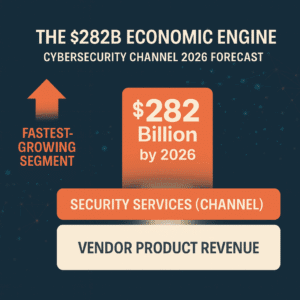
A $282 Billion Cybersecurity Channel Market
The report draws on Canalys data, projecting that the global cybersecurity channel will reach $282 billion by 2026. Managed security services alone are expected to account for nearly $93 billion, growing 15% year over year — outpacing all other IT service categories.
Jay McBain, Chief Analyst at Canalys, said, “Security services are the fastest-growing segment of the IT channel. Providers who embrace security are capturing the market’s growth.”
This economic shift is creating an 18-month window of opportunity for forward-thinking MSPs. Those who integrate AI-powered defenses and cyber insurance readiness into their offerings can achieve rapid, sustainable growth.
The Uninsurable Risk and the Role of Cyber Insurance
As the financial impact of cyber incidents intensifies, SMBs increasingly view cyber insurance as essential protection rather than an optional safeguard. Yet many policies now include stricter requirements for coverage — from multi-factor authentication to real-time monitoring.
The report warns that some SMBs may soon become “uninsurable” if they fail to meet these baseline security standards. Cyber insurers are tightening terms, requiring verifiable proof of cyber hygiene before writing policies.
By aligning technology, governance, and financial protection, Cork’s Vantage platform aims to make cyber insurance achievable again for small businesses. The platform integrates risk assessment, continuous monitoring, and financial coverage, allowing MSPs to offer clients measurable protection.
“Clients don’t just need more tools; they need guarantees,” said Dan Candee, CEO of Cork Protection. “That’s why Cork exists — to give MSPs visibility and the financial backing to protect every client.”
Watch Cork DEO Dan Candee on the Cyber Insurance News Podcast
Strategic Recommendations for SMBs
The report outlines four urgent steps small businesses should take:
- Treat cybersecurity as a core business risk. Budget for it like insurance or legal compliance, not an IT expense.
- Work only with security-first MSPs. Providers must offer documented plans aligned with recognized frameworks such as CIS Controls.
- Modernize data recovery and asset management. Outdated systems create blind spots that attackers exploit.
- Align with insurers early. Ensure your cyber coverage reflects your actual exposure and includes business continuity provisions.
A Shifting Channel and a Historic Opportunity
The report paints a picture of urgency and opportunity. AI has changed the rules of engagement, but it also provides defenders with new tools to automate threat detection and reduce response time.
As Jon McNeill concluded, “The leaders who address risk head-on and build a culture of proactive defense will capture the market.”
For SMBs, cyber resilience is no longer a matter of convenience; it’s survival. For insurers, it’s a wake-up call to innovate and collaborate. The era of static policies and reactive coverage is ending.
RELATED CYBER INSURANCE FOR SMALL BUSINESS POSTS
