

Estimated reading time: 7 minutes
Imagine a security guard in a control room. The cameras show every hallway. The alarms work. The guard sees a thief moving between rooms. Yet the guard cannot lock the doors. The thief keeps walking deeper into the building. That is the plain-language version of today’s breach containment problem.
In The Containment Gap: Exploring the Distance Between Detection and Resilience, produced by CyberEdge Group for Illumio, the numbers tell that story clearly. Most organizations say they can see unauthorized lateral movement. Many still struggle to stop it once it starts. The result is a dangerous gap between detection and action, allowing attackers to push deeper into systems after the alarm has sounded.
Detection Without Action Leaves Organizations Exposed
The research surveyed 700 IT and cybersecurity leaders across seven countries. The findings show strong confidence in detection. They also show widespread difficulty stopping attackers once they gain access.
The research found that 95% of surveyed organizations believe they can detect unauthorized lateral movement inside their networks. However, 46% of these organizations admit they struggle to actually stop or contain such movement once detected.
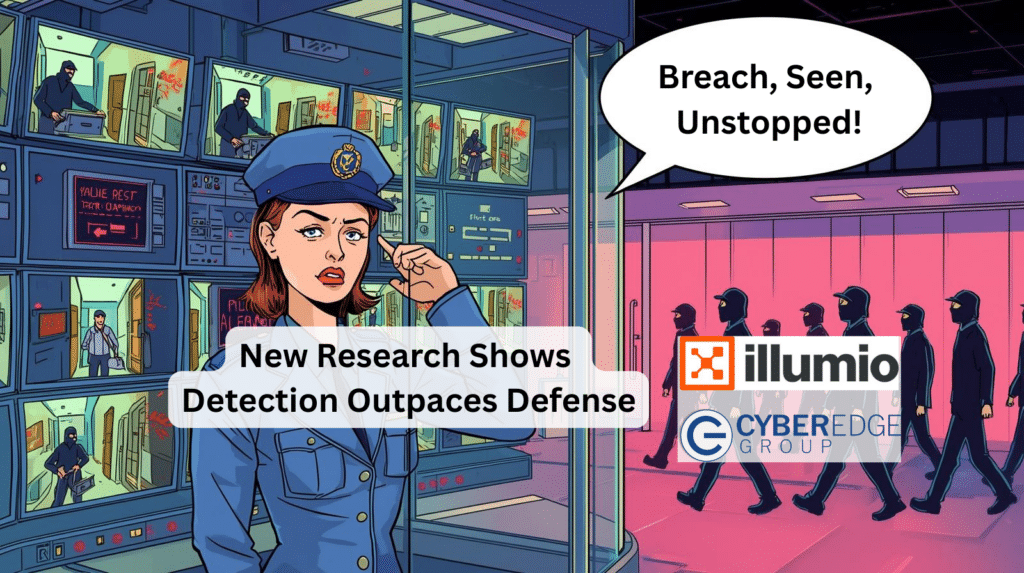
This divide creates a dangerous window during a cyberattack. Security teams may see intruders but fail to isolate them quickly enough to prevent damage. The report labels this challenge the containment gap.
“Containment delayed is containment lost,” said CyberEdge CEO Steve Piper. “Only a small minority of organizations can isolate compromised workloads in near real time.”
He added that many companies operate on timelines measured in hours or days. During that delay, attackers can escalate privileges and move deeper into systems.
The Containment Gap Explained
The containment gap is the lag between spotting threats and stopping attackers. Tools often detect, but rarely contain.
The research reveals a troubling pattern. Detection tools work well. Containment tools often lag behind.
The study shows:
- 95% feel confident detecting unauthorized lateral movement
- 87% believe they can contain attacks quickly
- 17% can isolate compromised assets in near real time
These numbers show a stark difference between perception and operational capability.
The report notes that the most damaging period of an attack occurs between detection and containment. Attackers exploit that time to expand their access.
Hidden Attack Paths Still Persist
Organizations rate their network visibility with an average confidence score of approximately 4 out of 5 across surveyed respondents, suggesting they feel strongly about visibility in certain parts of their infrastructure.
However, visibility drops when systems cross environment boundaries. Cloud-to-cloud and cloud-to-data center communications present major blind spots.
The study also found that 68% of organizations only identify previously unknown communication paths once per week or less often. These infrequently discovered pathways can present potential attack routes.
Security leaders may think they know their networks, but hybrid environments are constantly evolving. Attackers exploit blind spots to move laterally.
Breach Containment Speed Remains A Critical Weakness
Response time plays a decisive role during an active breach.
Only 17% of organizations isolate compromised workloads in near real time. Another 33% can act within minutes.
Meanwhile, 40% of organizations require hours to isolate compromised systems, and 11% take days or longer. These figures indicate a substantial delay in many organizations’ response times.
Attacker delays result in more network reach and greater damage.
“Most organizations can spot an intrusion, but stopping it is a different story,” said Raghu Nandakumara, vice president of industry strategy at Illumio.
He warned that AI-driven attacks are now moving faster and growing harder to interpret. Even small footholds can escalate rapidly.
AI-Risk And Threats Rise To The Top
The study results indicate that 55% of respondents now rank AI-driven attacks among their top three cybersecurity concerns, reflecting a rapid evolution in the threat landscape.
The survey identified the most pressing threats as:
- Data and intellectual property theft – 57%
- Operational disruption – 56%
- AI-driven attacks, including deepfakes – 55%
- Ransomware and extortion – 53%
These results show that organizations now expect hybrid attack methods. Traditional malware campaigns increasingly combine automation, social engineering, and AI-generated deception.
Watch Our Podcast
AI-Risk, Deepfakes, Cybercrime Scale, And Cyber Insurance Pressure
Cyber Risk Still Starts With Basic Weaknesses
Despite the rise of advanced threats, organizations remain most concerned about fundamental security gaps.
Respondents identified the top sources of cyber risk as:
- IT vulnerabilities – 66%
- Employee error or misconduct – 50%
- Lack of IT and OT integration – 50%
- Credential theft and privilege escalation – 45%
These findings suggest many breaches still originate from known weaknesses rather than unknown vulnerabilities.
The report states that exposure often results from a combination of technical gaps, operational complexity, and human error.
Microsegmentation Gains Momentum
Organizations increasingly view microsegmentation as a key strategy for limiting breach impact.
According to the research, 93% of surveyed organizations use some form of segmentation, though the extent and type of implementation vary widely.
Most still rely on traditional network-based firewalls. These hardware tools struggle in dynamic cloud environments where IP addresses change frequently.
Modern microsegmentation approaches rely on software-defined controls that follow workloads across environments.
Organizations report several benefits from segmentation strategies:
- Faster detection and response
- Stronger breach containment
- Improved visibility into traffic patterns
Yet adoption challenges remain. The most common barriers include cost, limited visibility into application dependencies, and integration complexity.
Get The Cyber Insurance News Upload Delivered
Subscribe to our newsletter!
Why Detection Alone Fails
The report argues that the cybersecurity industry has spent decades focusing on prevention and detection. That approach no longer works against modern threats.
Detection alerts security teams to an incident. Containment stops it from spreading.
Without containment, detection simply confirms that attackers have already gained access. The report argues that organizations must shift toward resilience, placing a primary focus on containment to truly reduce risk. Limiting attacker movement inside networks is now the key takeaway. Works.
The Future Of Breach Containment
The researchers recommend a new security model focused on containment rather than perimeter defense.
This strategy includes three key shifts:
- Focus on containment speed rather than detection speed.
- Replace implicit internal trust with zero-trust controls.
- Apply consistent security policies across hybrid environments.
Modern cyber resilience depends on limiting lateral movement. If attackers cannot move freely, breaches remain smaller and easier to control.
The report concludes that organizations already recognize the problem. The challenge now lies in executing. Closing the containment gap is the main takeaway of the research. This will determine whether security teams merely observe attacks or actually stop them.
FAQ: Understanding The Containment Gap In Cybersecurity
The containment gap describes the delay between detecting a cyber intrusion and stopping it from spreading. Security tools may detect suspicious activity quickly. Many organizations still struggle to isolate affected systems before attackers move deeper into networks.
Detection tools monitor activity and generate alerts. Containment requires the ability to isolate systems or block internal traffic instantly. Complex networks, hybrid cloud environments, and legacy systems often slow this response.
Lateral movement occurs when attackers move from one compromised system to others inside a network. They use stolen credentials or trusted connections to reach more valuable targets.
Recent research shows the gap is widespread. Many organizations report strong confidence in detecting attacks. Nearly half still struggle to stop unauthorized lateral movement after it begins.
Attackers expand their access quickly once inside a network. Each minute allows them to steal data, escalate privileges, or disrupt operations. Rapid containment limits damage and reduces financial impact.
FAQ: Containment Strategies And Cyber Risk
Breach containment focuses on stopping attackers from spreading through a network after an initial intrusion. Security teams isolate compromised workloads, restrict communications, and block further access.
Microsegmentation divides systems into smaller security zones. Each workload or application receives its own policy controls. This prevents attackers from moving freely between systems.
Modern infrastructure spans data centers, multiple clouds, and remote endpoints. Connections between these environments change constantly. Security teams may detect suspicious activity but lack clear visibility into every pathway.
Organizations increasingly worry about AI risk, deepfake impersonation, and automated attack campaigns. Data theft, operational disruption, and ransomware also remain major concerns.
Security teams should automate response actions, implement microsegmentation, and adopt zero-trust architecture. Faster isolation capabilities and better visibility across environments help close the containment gap.
Related Cyber Insurance Posts
- Millions Of Potential Cyber Insurance Policy Customers Already Exposed, DynaRisk
- Diversification and Mitigation Slash Cyber Insurance Losses by 60%
- Data Governance and Cyber Risk: Why Data Sprawl Is the Hidden Liability – NEW PODCAST
- Cybersecurity Starts With Understanding: Graylog’s Kimber Spradlin on Data Clarity, AI Limits, Cyber Hygiene and Mom
- Cyber Security Insurance For Small Business. What to Know.
