

Estimated reading time: 4 minutes
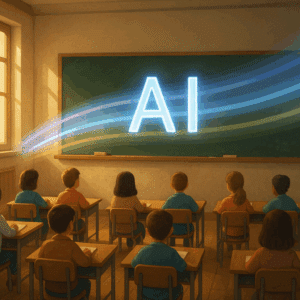
If you hear “AI Education,” what do you think? Cheating and diminished learning, but a new report raises another issue: cybersecurity. We’ve reported on this issue and the critical role schools play. Keeper Security’s “AI in Schools: Balancing Adoption With Risk” follows that with a clear warning. AI sits in classrooms. Defenses lag. The report surveys 1,460 education leaders in the U.S. and the U.K. It tracks adoption, policy, and threat exposure across K-12 and higher education.
Adoption is Widespread – Guardrails Trail
Eighty-six percent of institutions allow student use of AI tools. Ninety-one percent permit faculty use. Most rely on guidelines rather than formal policies. The report states plainly: “AI is the norm in classrooms and faculty offices.” It adds: “Students are primarily using AI for supportive and exploratory tasks.”
Cybersecurity Incidents Are Already Here
Forty-one percent of schools report AI-related cyber incidents. Issues include phishing, misinformation, and harmful content generated by students. Nearly 30% report harmful content such as student deepfakes. Most incidents were “contained quickly,” yet many leaders remain unsure what occurred. That gap signals weak monitoring.
Confidence Lags
Ninety percent of leaders express concern about AI-related threats. Only 26% feel “very confident” in recognizing deepfakes or AI-enabled phishing. The report warns that “awareness… is reassuringly high,” but “the depth of understanding is uneven.”
Stakes for AI Education
Keeper’s CEO Darren Guccione frames the urgency. “AI is redefining the future of education, creating extraordinary opportunities for innovation and efficiency,” he says. “But opportunity without security is unsustainable.” He urges “a zero-trust, zero-knowledge approach.”
Anne Cutler, Keeper’s Cybersecurity Evangelist, stresses strategy. “Cybersecurity is no longer a back-office function – it is central to protecting students, enabling educators, and preserving the integrity of institutions.” Decisions in early adoption will “shape… how confidently society embraces it.”
Watch Our OpED – Redefining Critical Infrastructure: Cybersecurity & Schools. Is It Critical?
The Overview: Adoption Outpaces Preparedness
The report opens with a simple premise: “Artificial Intelligence (AI) is transforming education.” Teachers use it for lessons, communications, and analysis. Students use it for research, brainstorming, and creative projects. Time savings rise. Risks rise with them. “Adoption is outpacing preparedness.”
The Road Ahead: Govern, Secure, Guide
The study sets an actionable agenda. “The question today is not whether to adopt AI, but how to govern, secure and guide its use while controlling existing and emerging threats.” It urges immediate steps: enforce MFA, adopt PAM, teach strong passwords, and deploy real-time detection for deepfakes and AI phishing. It also calls for regular policy reviews.
Three imperatives stand out
- Close the policy gap.
- Strengthen resilience with training and tools.
- Safeguard trust through privacy and ethics.
The following two years look decisive.
Get The Cyber Insurance News Upload Delivered
Subscribe to our newsletter!
Fragmented Safeguards
Policy work is uneven. Just over half have detailed policies or informal guidance in place. Less than 60% deploy AI-detection tools or student education programs. Only a third report dedicated budgets, and just 37% have incident response plans. Institutions experiment with faculty training models, from formal programs to peer-based approaches. But, perceived detection reliability remains “moderate at best.”
Threat Perceptions Inside Schools
Top concerns include student privacy violations, learning disruption, and deepfake impersonation. Leaders also worry about bias, reputational harm, and financial damage. The sector sees rising risk and uneven readiness.
Practical Implications for Cyber Insurers
Loss scenarios now include deepfake-driven social engineering against staff. Schools face AI-perfected phishing and data leakage from unmanaged tools. Policies should reward posture improvements: zero-trust controls, PAM, MFA, and detection coverage for synthetic media. Underwriting can probe AI governance maturity and incident response drills.
Why this matters now
AI Education expands daily. Attackers iterate faster. The report shows widespread adoption and fragmented safeguards. Leadership must align policy, training, and zero-trust architecture. As the report concludes, schools must “keep pace with adoption while staying ahead of the evolving threat landscape.”
Related Posts
